

- Fresh Daily Detailing
Why Exterior Car Detailing Is Essential for Protecting Your Vehicle’s Finish
Vehicle paint systems are engineered to withstand environmental exposure, but they are not indestructible. Modern automotive finishes consist of multiple layers: electrocoat primer, base color coat, and a thin clear coat designed to protect against ultraviolet radiation, chemical contaminants, and physical abrasion. Over time, this protective clear coat degrades due to oxidation, embedded contaminants, improper washing techniques, and environmental stress.
Many vehicle owners associate shine with protection, yet gloss alone does not indicate surface integrity. Proper exterior car detailing addresses contamination removal, defect correction, and protective barrier application in a structured process that preserves long-term paint health. In high-altitude environments where UV radiation is stronger and seasonal weather shifts are aggressive, surface deterioration can occur faster than expected. Understanding why professional intervention matters helps prevent irreversible paint damage.
Understanding Modern Automotive Paint Systems
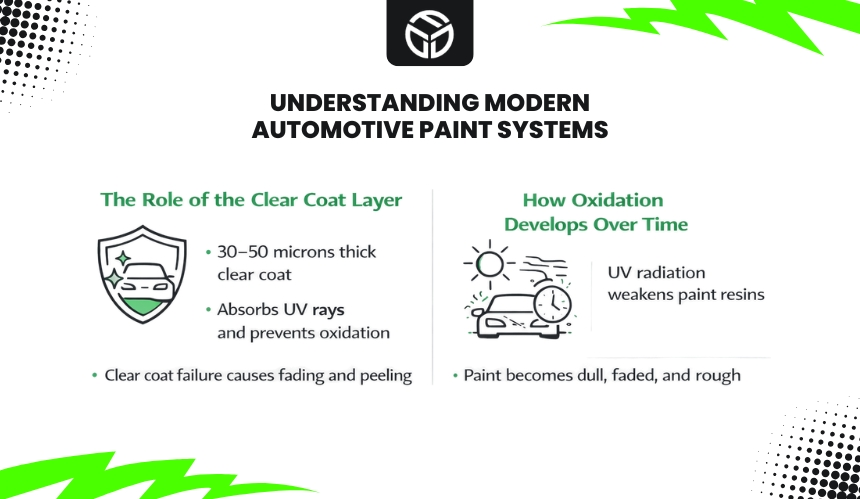
To appreciate the importance of detailing, it is necessary to understand how vehicle paint is structured and why it fails.
The Role of the Clear Coat Layer
The clear coat is typically 30–50 microns thick and serves as the vehicle’s first line of defense. It absorbs UV radiation and shields the base color coat from oxidation. Once this layer thins excessively or becomes compromised, the paint beneath begins to fade and deteriorate.
Excessive polishing, harsh chemicals, and automated car washes can gradually reduce this protective layer. Once clear-coat failure begins, visible as peeling or chalking, repainting becomes the only corrective measure.
How Oxidation Develops Over Time
Oxidation occurs when UV radiation breaks down paint resins, leading to dullness and fading. High-altitude exposure intensifies this process due to thinner atmospheric filtration. Vehicles parked outdoors for extended periods experience accelerated clear coat degradation.
In regions such as Highlands Ranch, CO, strong sunlight combined with winter moisture creates a cycle of expansion, contraction, and surface stress that gradually weakens paint integrity.
Environmental Contaminants That Damage Exterior Surfaces
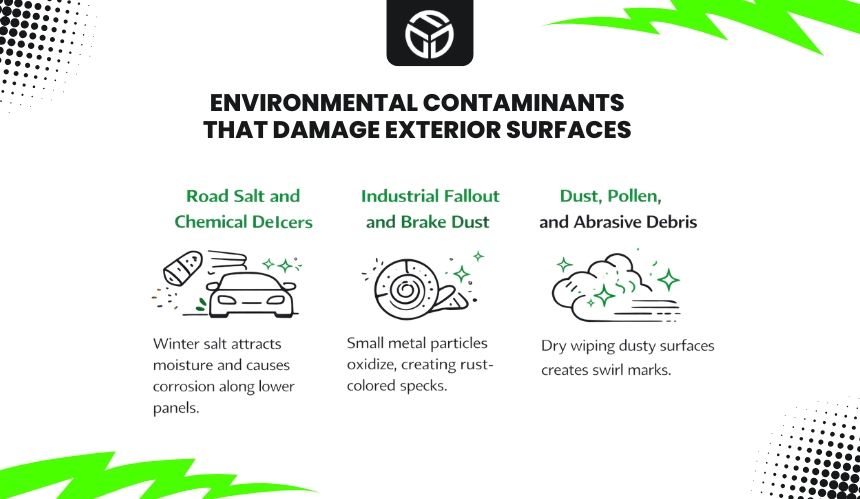
Environmental contamination is frequently microscopic and therefore unnoticed during routine washing, yet it gradually embeds into the clear coat and initiates chemical reactions that weaken paint integrity. Airborne pollutants, industrial fallout, brake dust particles, tree sap mist, acid rain residues, and road treatment chemicals can bond to the surface at a molecular level.
Road Salt and Chemical De-Icers
Winter road treatment chemicals cling to lower panels and wheel wells. These salts attract moisture, creating corrosive conditions that accelerate rust formation and clear coat etching.
Industrial Fallout and Brake Dust
Microscopic metal particles are embedded in paint surfaces. These particles oxidize when exposed to moisture, causing small rust-colored spots that can penetrate the clear coat if not removed properly.
Iron decontamination treatments during exterior car detailing safely dissolve these embedded particles.
Dust, Pollen, and Abrasive Debris
Dry wiping dusty surfaces causes micro-scratches. Over time, these scratches create swirl marks that scatter light and reduce clarity and gloss. Proper lubrication during washing prevents abrasive damage.
The Science Behind Exterior Car Detailing
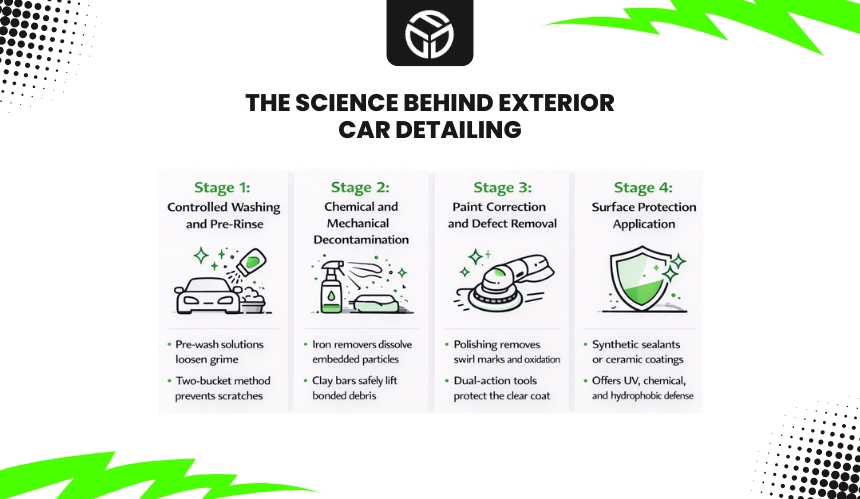
Professional detailing is a structured, multi-stage process designed to restore and protect paint without compromising clear coat thickness.
Stage 1: Controlled Washing and Pre-Rinse
High-foaming pre-wash solutions loosen surface grime. Two-bucket hand washing systems reduce cross-contamination. pH-balanced shampoos prevent stripping protective layers.
Stage 2: Chemical and Mechanical Decontamination
Chemical iron removers dissolve ferrous contamination. Clay bar treatment mechanically lifts bonded debris from the surface. This process creates a smooth foundation for correction and protection.
Skipping decontamination reduces coating adhesion and compromises durability.
Stage 3: Paint Correction and Defect Removal
Paint correction uses measured polishing techniques to remove swirl marks, light scratches, and oxidation. Professionals use paint thickness gauges to ensure safe correction limits are met. Dual-action polishers minimize heat buildup and reduce hologram formation.
Correction restores optical clarity without unnecessarily thinning protective layers.
Stage 4: Surface Protection Application
Protection options include synthetic sealants and ceramic coatings. Ceramic coatings form semi-permanent bonds that enhance chemical resistance, UV protection, and hydrophobicity. These coatings repel water and contaminants, making maintenance easier.
Climate-Based Reasons Detailing Is Critical
Environmental exposure directly influences detailing frequency and the choice of protection.
High-Altitude UV Exposure
Stronger UV radiation accelerates oxidation and clear coat breakdown. Vehicles exposed to the elements daily require more robust protection strategies than those stored indoors.
Freeze–Thaw Cycles
Temperature fluctuations cause microscopic expansion and contraction in paint surfaces. Moisture trapped in small defects worsens cracking during freezing conditions.
Seasonal Dust and Storm Debris
Wind-driven particles create fine scratches that accumulate over time. Regular maintenance prevents the buildup of defects that later require aggressive correction.
Drivers in Highlands Ranch, CO, frequently encounter a combination of UV intensity, winter road salt, and rapid seasonal shifts, increasing the need for structured exterior maintenance.
Exterior Protection Options Compared
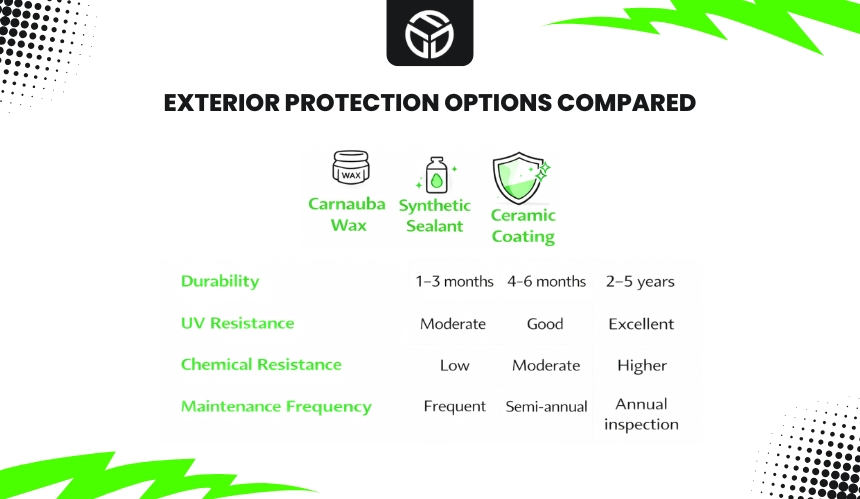
Not all protection methods provide equal durability.
Protection Type | Durability | UV Resistance | Chemical Resistance | Maintenance Frequency |
Traditional Wax | 1–3 months | Moderate | Low | Frequent |
Synthetic Sealant | 4–6 months | Good | Moderate | Semi-annual |
Ceramic Coating | 2–5 years | Excellent | High | Annual inspection |
Ceramic coatings offer superior resistance against road salt, bird droppings, and environmental contaminants.
Long-Term Financial Benefits of Professional Detailing
Paint preservation protects resale value. Vehicles with well-maintained factory finishes consistently command higher market prices compared to those requiring repainting.
Preventing Clear Coat Failure
Routine maintenance prevents the buildup of oxidation that leads to peeling or chalking.
Reducing Future Correction Costs
Early intervention minimizes the need for aggressive compounding later, preserving clearer coat thickness over time.
A skilled exterior car detailing process prioritizes preservation rather than cosmetic enhancement alone.
Signs Your Vehicle Requires Exterior Detailing
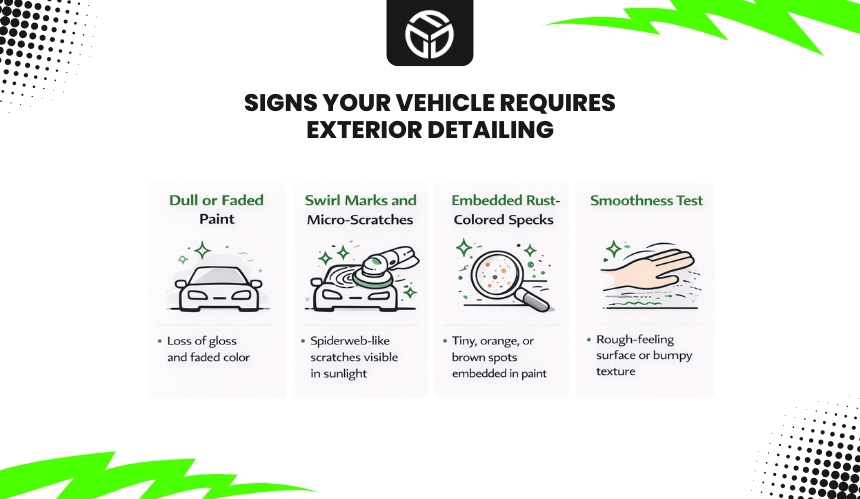
Exterior paint deterioration rarely happens all at once. It develops progressively through contamination buildup, oxidation, and mechanical abrasion. Recognizing early warning signs allows for corrective action before clear-coat damage becomes permanent. Ignoring these indicators often leads to aggressive compounding later, reducing available clear-coat thickness and shortening the lifespan of the factory finish.
Below are measurable and observable signs that professional intervention is necessary.
Visual Indicators of Surface Degradation
Visual inspection under direct sunlight or controlled LED lighting often reveals paint defects that are invisible in shade.
Dull or Faded Paint
Loss of gloss typically signals oxidation. Ultraviolet radiation breaks down paint resins over time, causing the surface to appear chalky or hazy. When gloss diminishes, it often means the topmost layer of clear coat has begun to degrade. Early-stage oxidation can be corrected through polishing, but prolonged neglect may require heavier correction that removes more protective material.
Swirl Marks and Micro-Scratches
Swirl marks are fine circular scratches commonly caused by automated car washes, improper drying towels, or dry wiping dusty panels. These micro-abrasions scatter light, reducing reflectivity and depth. Under sunlight, they appear as spiderweb-like patterns across darker paint colors. Accumulated swirl marks indicate the need for paint correction rather than simple washing.
Water Spot Etching
Mineral deposits from hard water can chemically bond to paint surfaces. If water spots remain visible after rinsing or washing, they may have etched into the clear coat. Left untreated, mineral etching can penetrate deeper layers, making correction more complex.
Embedded Rust-Colored Specks
Small orange or brown dots on light-colored paint often indicate iron contamination from brake dust or industrial fallout. These particles oxidize when exposed to moisture and gradually embed deeper into the surface. Chemical iron decontamination during exterior car detailing dissolves these particles safely before they cause permanent pitting.
Surface Texture and Tactile Indicators
Paint condition is not only visible, it can also be felt.
The Smoothness Test
After washing and drying the vehicle, gently glide a clean hand across the paint surface. Properly maintained paint should feel smooth and glass-like. A gritty or sandpaper-like texture signals the presence of bonded contaminants such as tar, industrial fallout, or environmental debris.
Hydrophobic Performance Decline
If water no longer beads or sheets off the surface, protective layers may have degraded. Loss of hydrophobic behavior suggests that wax, sealant, or coating protection has diminished and requires reapplication.
Increased Drag During Washing
When wash mitts feel resistant or drag across panels, contamination is likely embedded within the clear coat. This increases friction during cleaning, which can introduce additional swirl marks.
Protecting Paint Is Protecting Value
Exterior surfaces endure constant environmental stress. UV radiation, salt exposure, airborne contamination, and improper washing techniques gradually weaken the integrity of the clear coat. Ignoring these factors leads to oxidation, fading, and costly repainting.
Professional exterior car detailing is not simply a cosmetic enhancement. It is a preventive maintenance strategy designed to preserve factory paint, maintain resale value, and protect against climate-driven deterioration. When environmental conditions are considered, and correction techniques are applied responsibly, vehicle finishes remain structurally sound and visually refined for years.
Frequently Asked Questions
How often should exterior car detailing be performed?
Most vehicles benefit from professional detailing every 4–6 months. High-exposure environments may require maintenance every 3–4 months to prevent the buildup of oxidation and contamination.
Does exterior detailing remove scratches?
Light scratches within the clear coat can often be corrected. Deeper scratches penetrating the base coat require repainting.
Is ceramic coating necessary after detailing?
Ceramic coatings provide extended UV and chemical resistance. While not mandatory, they significantly increase the durability of protection compared to wax.
Can road salt permanently damage paint?
Prolonged exposure to salt can etch the clear coat and accelerate corrosion if not removed promptly through proper washing and decontamination.
What is the difference between washing and detailing?
Washing removes loose dirt. Detailing includes decontamination, defect correction, and protective application designed for long-term preservation.